
Plan and create budget items
Budget is accessible directly from the main menu in the left sidebar.
Note:
- To create budget items, you must have Manage access rights to the Budget section and at least Read access rights to those activities and participants you want to assign budget for (see "Roles, access levels, and access rights").
- In addition, the current plan version must be in the Edit mode (see "Manage workspace plan versions").
Tip:
- It is recommended to create activities and participants before creating budget items in your workspace, because budget items are assigned to both of them.
- If you have already developed your budget outside EMDESK, you can import your budget data into your EMDESK workspace.
Information: For EU-funded research projects, budget items represent your planned direct costs. Each budget item is assigned to a cost category (for example Personnel, Travel or Equipment); indirect costs and funding are then calculated automatically. You can view, filter, and sort budget items in the Budget table view and export budget data in Excel (.xlsx) or CSV format.
Follow these instructions to create a budget item.
- 1
-
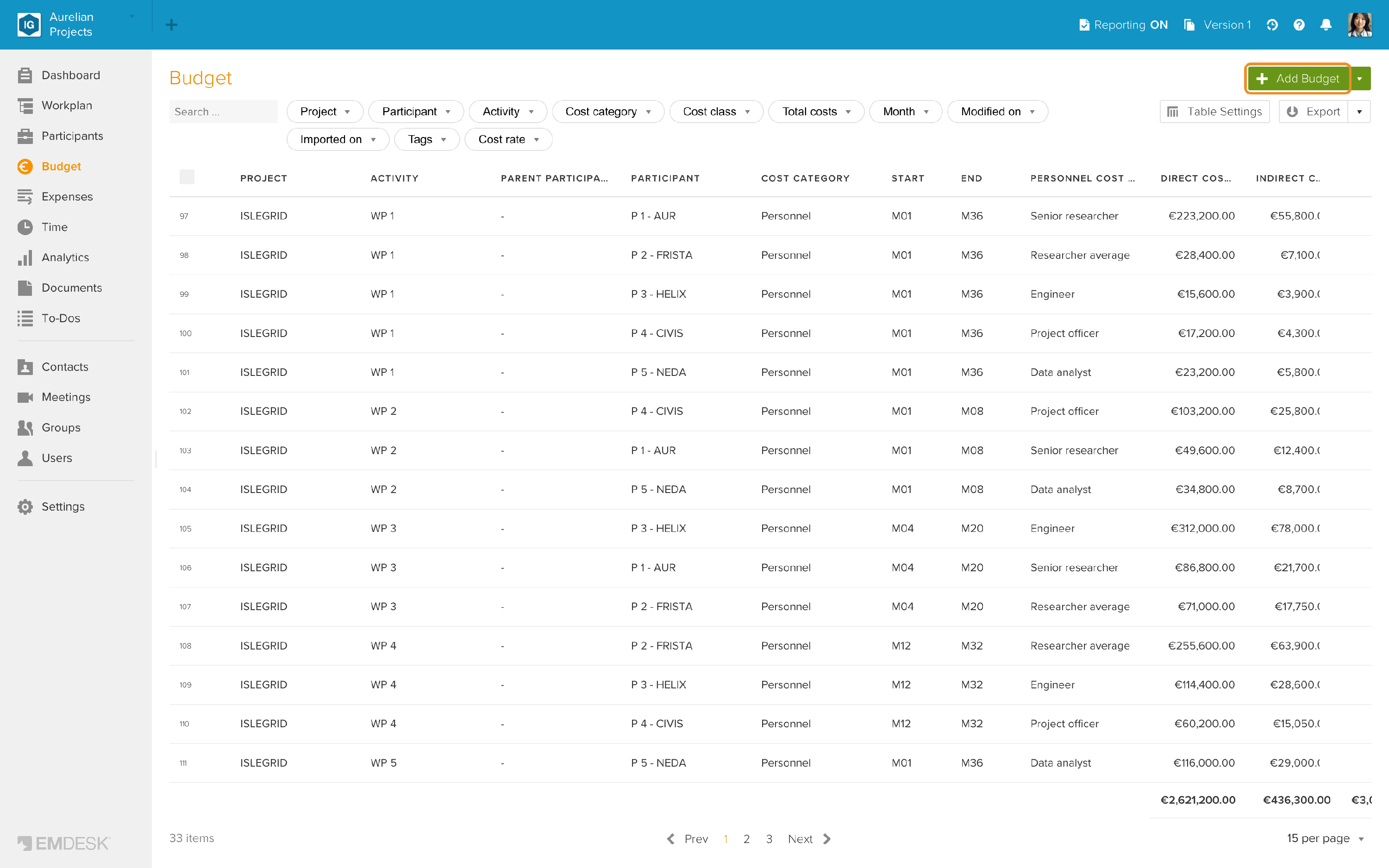
Click Budget in the main menu and then click + Add Budget at the top right.
- 2
-
A sidebar opens where you define the budget item:
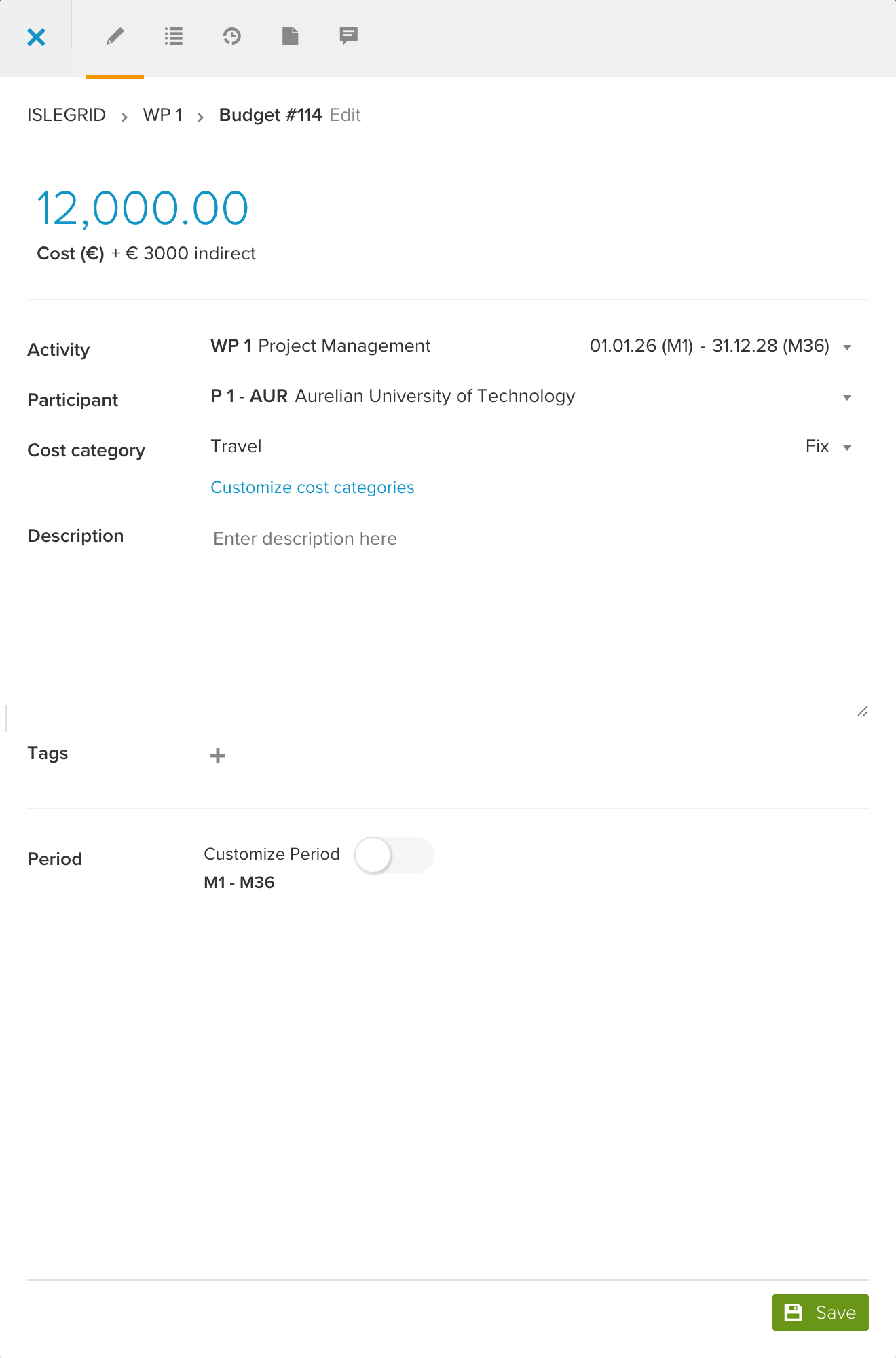
Required fields:
- Cost (€): Enter the amount of planned costs at the top of the sidebar. The indirect costs are shown next to it (+ € … indirect); they are calculated automatically from the indirect cost rate that covers the participant and the cost category: a rate set for this participant in its Financial Profile, otherwise the workspace-wide rate in Settings › Customization (see "Create and edit indirect cost rates"). If the indirect costs show 0.00, no indirect cost rate covers this participant and cost category yet. Funding is calculated automatically as well, from the funding rules.
- Activity: Select the activity for which you plan the budget. Its start and end are shown next to it.
- Participant: Select the participant where the costs will be incurred.
- Cost category: Select a cost category of the type Fix.
Note: Cost categories can be customised under the Customisation settings (or via Customize cost categories in the sidebar). There are 2 types of cost categories: fixed amounts (Fix) and rate-based amounts (Rate). Rate-based amounts, such as personnel costs, depend on effort and a rate; fixed amounts are costs for goods and services.
Information: To create a rate-based personnel budget, read "Plan and create personnel budget".
Optional fields:
- Description: Enter a short description of the budget item.
- Tags: Classify and label the budget item with tags.
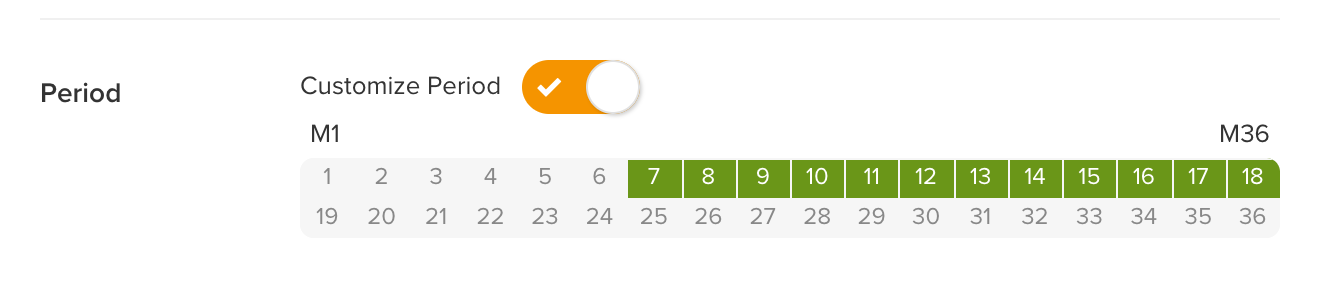
- Period: By default, a budget item covers the whole duration of its activity (e.g. M1 - M36) and moves with it when the activity is rescheduled. To plan it for part of the activity only, switch on Customize Period, click the first month and then the last month of the period in the month bar. The period can only lie within the activity. If the activity is moved later, the customised period moves along and is shortened if it no longer fits.
- 3
-
When all information is filled in, click Save at the bottom of the sidebar.
Note: Activity, participant and cost category should be set for every budget item. If one of them is missing, the item is still listed in the Budget table, with an empty value in that column. Such items are not included in the totals in the Workplan, Participants and Analytics.
Note: Read here how to delete budget items.