
Creating, editing, and organising participants
Participants are everyone who contributes to your projects: partner organisations, and below them departments, teams or individual staff members. You link participants to activities, budget items and expenses, and each participant has a financial profile with its cost rates.
💡 Note:
- To create, edit or move participants, you need Manage rights to Participants (see Roles and access rights), and the latest plan version must be editable.
- Already have a list of participants? Import it instead of creating each one.
Creating a participant
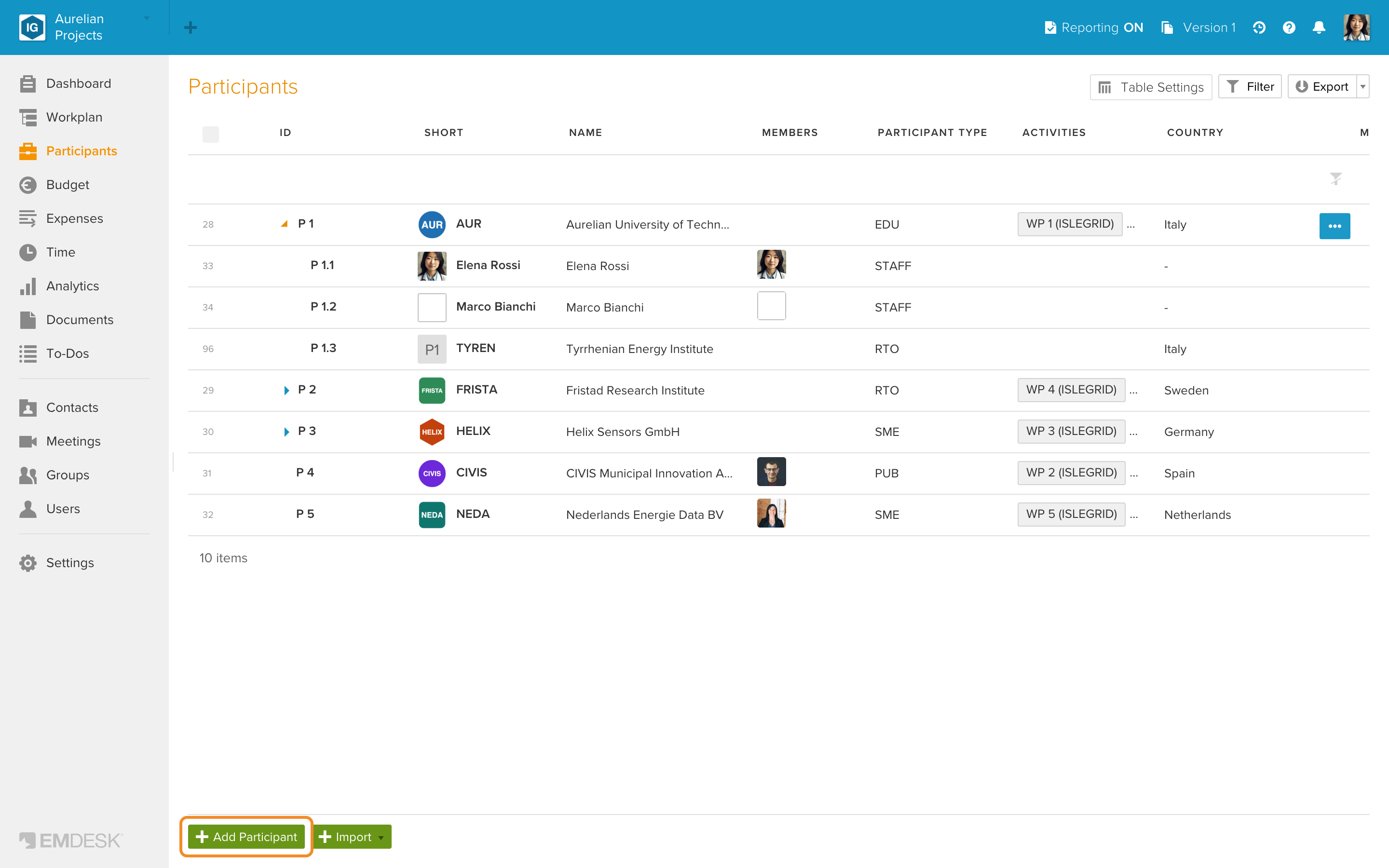
- Open Participants and click Add Participant at the bottom of the table.
- In the sidebar, replace the suggested Name (e.g. Participant P 6) and Short/Code, and choose the Participant Type. All other details are optional (see Participant details).
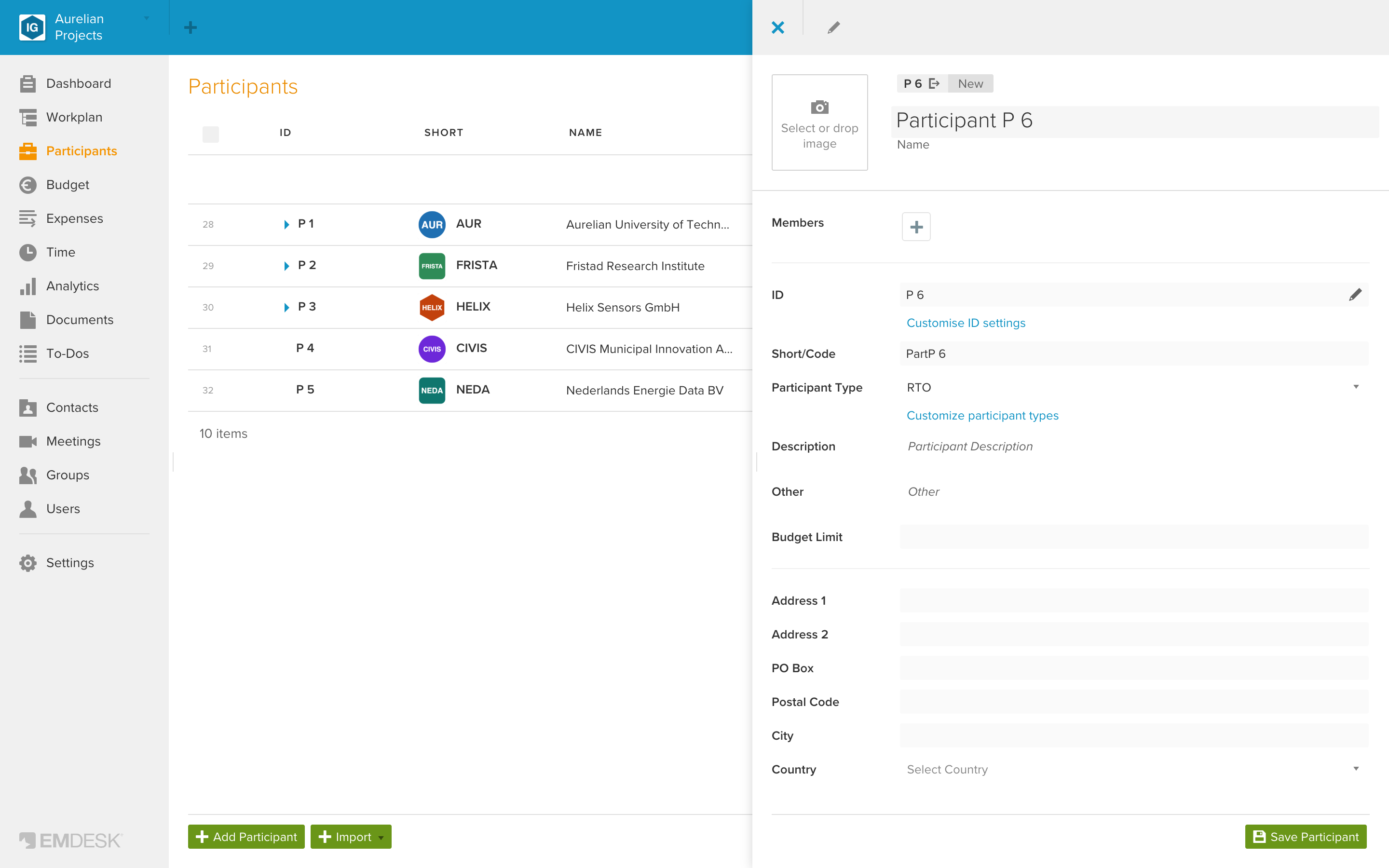
- Click Save Participant. The new participant is added at the end of the table.
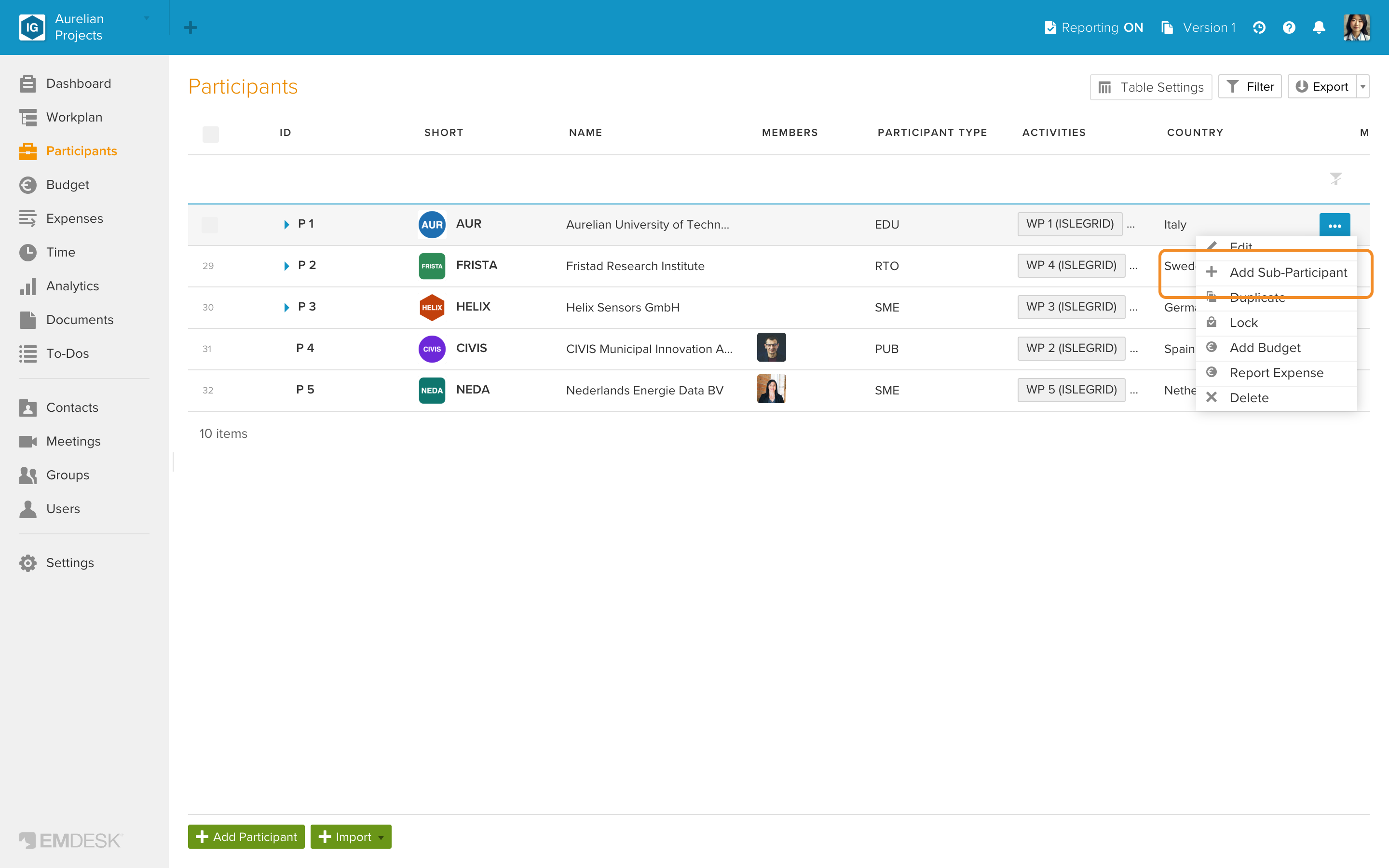
Tip: To create a participant directly under another one, for example a staff member under an organisation, open the … menu of the parent row and select Add Sub-Participant.
Participant details
Click a participant in the table to open its sidebar. Change the details and click Save Participant.
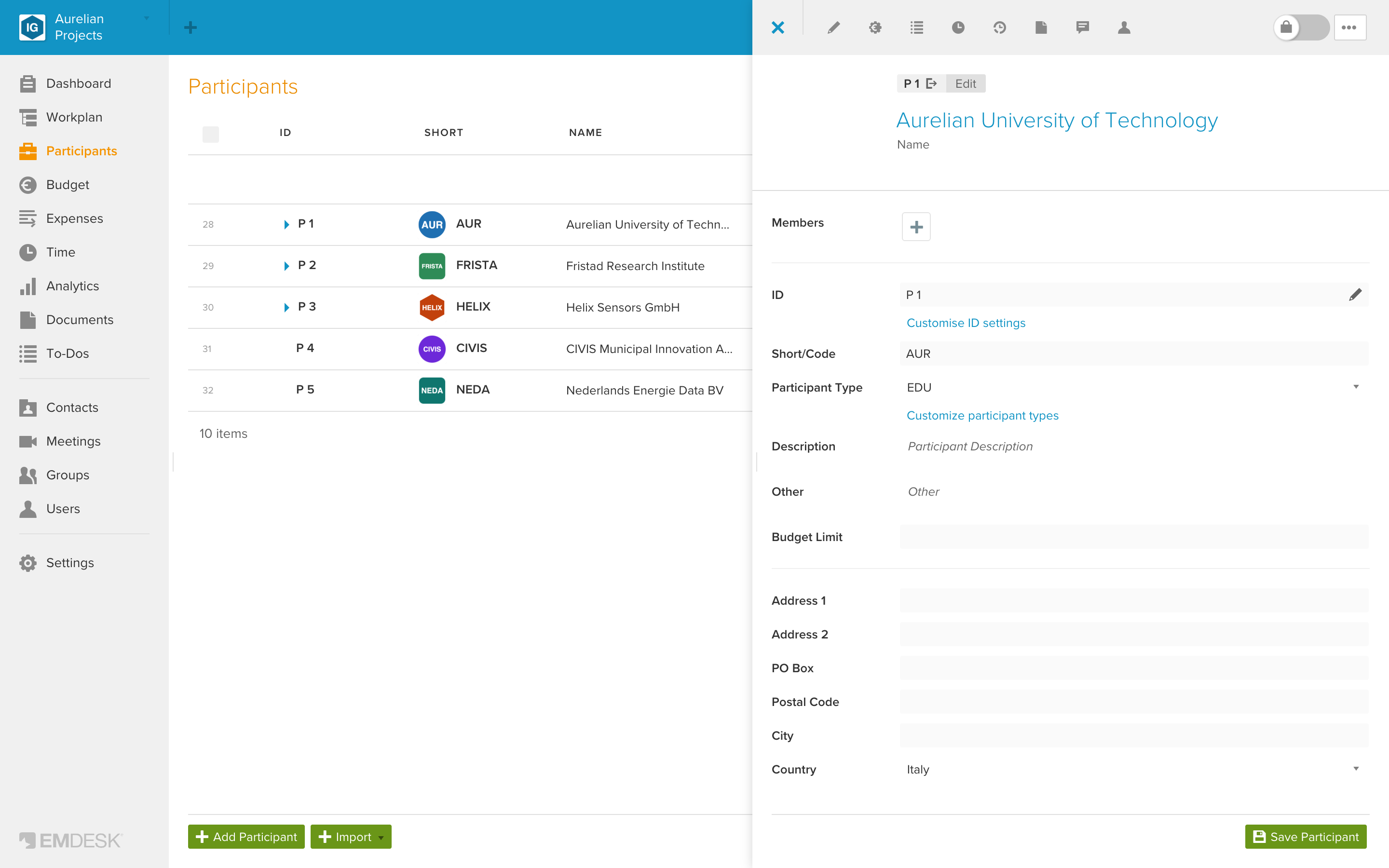
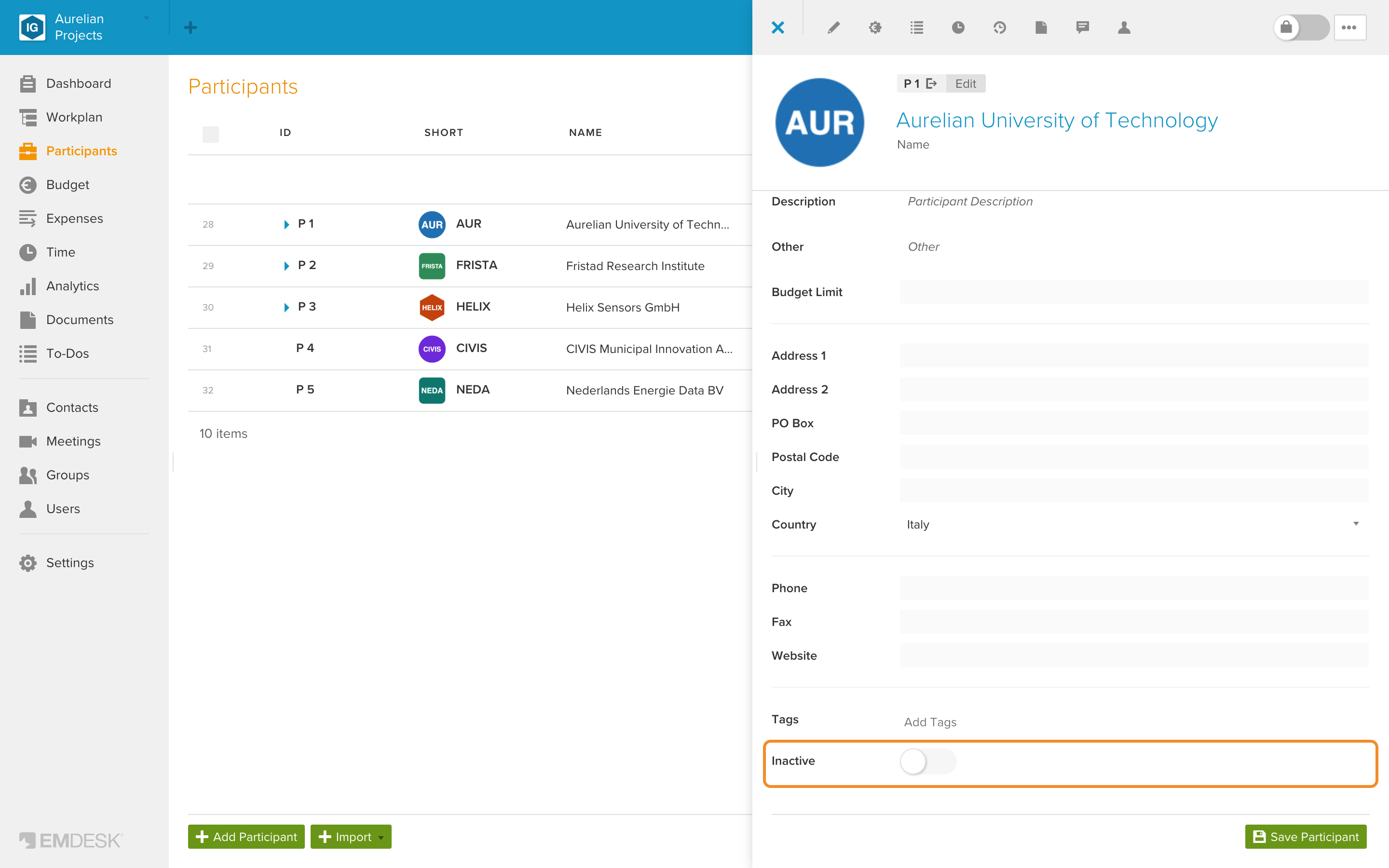
| Logo | Click the image area or drop an image file on it, e.g. the logo of an organisation or a photo of a person. |
| Name | The full name, e.g. Aurelian University of Technology or Elena Rossi. |
| Members | The users who belong to this participant, e.g. the staff of an organisation. Members can still be changed when the participant is locked. |
| ID | Set automatically according to the position in the table, e.g. P1 or P1.2. Click the pencil to enter your own ID instead. Admins and Managers can change the ID format with Customise ID settings. |
| Short/Code | The short name, e.g. AUR. It is shown in most lists and pickers. |
| Participant Type | E.g. Research organisation or SME. Admins and Managers can add a new type directly in the dropdown, or manage all types with Customize participant types (Settings › Customization › Participant Types). |
| Description, Other | Free text. |
| Budget Limit | The maximum budget you want to allow for the participant, in the currency of the workspace, e.g. its total budget from the grant agreement. It is a warning, not a hard limit: you can still add budget items and expenses. In the Participants table, the Budget column turns red when the planned budget exceeds the limit, and the Budget Limit column (show it with Table Settings) turns red when the expenses exceed it. |
| Address and contact fields | Address 1 and 2, PO Box, Postal Code, City, Country, Phone, Fax and Website. |
| Tags | Keywords for filtering, see Using tags. |
| Inactive | For participants that no longer take part, e.g. a partner that left the consortium. An inactive participant can no longer be selected for activities and budget items; existing links stay unchanged, and its sub-participants become inactive too. In the table it is marked with a pause icon. Available after the participant has been saved. See Deactivate and activate participants. |
Sub-participants and moving
Participants can be arranged in levels. The ID shows the level: P1 is on the first level, P1.2 is the second sub-participant of P1. How many levels you use and what they mean is up to you. The following structures are only examples:
Example 1: a Horizon Europe consortium
| P1 Aurelian University (coordinator) | Beneficiary |
| P1.1 Aurelian Research Foundation | Affiliated entity of P1 |
| P1.2 Elena Rossi | Staff member of P1 |
| P2 Fristad Research Institute | Beneficiary |
| P3 Helix Sensors GmbH | Beneficiary |
| P4 CIVIS Municipal Innovation Agency | Associated partner (no EU funding) |
In Horizon Europe, affiliated entities are organisations with a legal or capital link to a beneficiary, e.g. a subsidiary or a foundation of a university. They carry out their own tasks and declare their own costs, but do not sign the grant agreement (Article 8 of the Model Grant Agreement). As a sub-participant, an affiliated entity gets its own budget items, expenses and cost rates, and is still shown under its beneficiary.
Example 2: a company managing several projects
| P1 Engineering | Department |
| P1.1 Hardware team | Team |
| P1.1.1 Jonas Weber | Staff member |
| P2 Sales | Department |
| P3 Sensor Supplies Ltd | External supplier |
Here the participants are the company's own departments, teams and people. They are linked to the activities of all projects in the workspace, so you can see who works on what across projects.
Tip: Admins and Managers can change the format of the IDs per level, e.g. B1 for beneficiaries, with Customise ID settings in the sidebar.
To move a participant to another position or under another participant:
- Open the participant's sidebar.
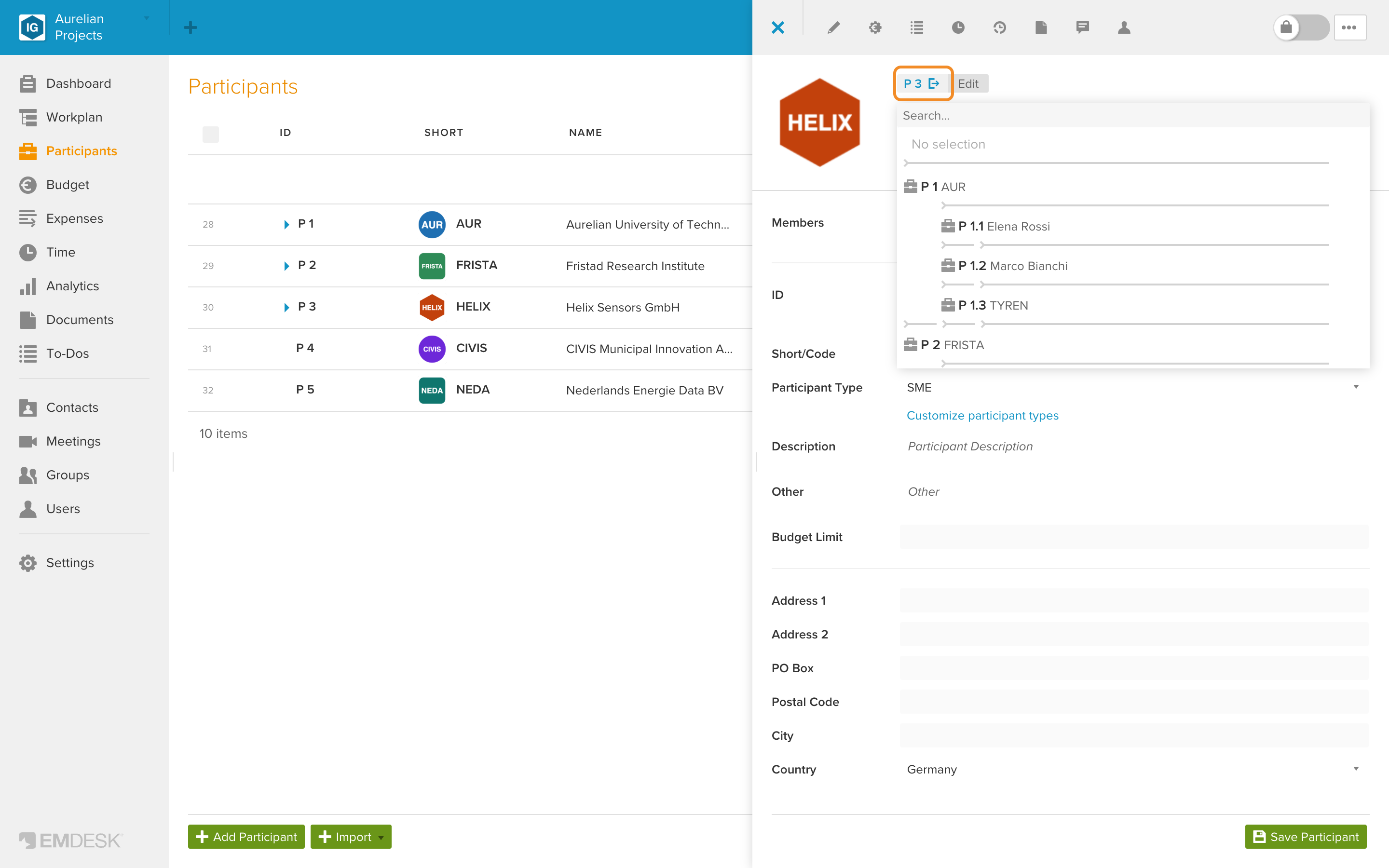
- Click its ID at the top of the sidebar (e.g. P 3). A list of all participants opens, with a line between each of them.
- Click the line at the position where you want the participant. An indented line below a participant makes it a sub-participant of that participant.
- Click Save Participant.
The IDs of all affected participants are renumbered automatically. To move several participants at once, use bulk editing (Move under).
More in the sidebar
- Financial Profile (gear icon at the top): the personnel and indirect cost rates of the participant, see Create and edit personnel cost rates.
- Further tabs show the participant's to-dos, tracked time, activity stream, documents and discussion. Managers also see the Access tab.
- The … menu of a row offers Add Sub-Participant, Duplicate, Delete, Add Budget, Report Expense and, for Admins and Managers, Lock. In the sidebar, Duplicate and Delete are in the … menu at the top right, and Admins and Managers lock with the padlock switch next to it.