
Create, Edit, and Organize Activities (like work packages or tasks)
In EMDESK, you can plan and manage your project work using the Workplan. This is where you add projects and activities (like work packages or tasks) and deliverables and milestones. These items can be structured flexibly—for example, as Projects → Work Packages → Tasks → Subtasks—to match your project needs.
The Workplan offers multiple view modes: Table, Kanban and Gantt views, each providing different ways to visualize and work with your activities.
If you have already developed your project schedule outside the EMDESK app, you can import your project data into the Workplan.
In EMDESK's flexible structure, the first level is called project, and items within projects are called activities. The system generates custom IDs automatically, which you can customize under the Customisation settings. You can also configure custom labels to match different work breakdown structures, such as projects → work packages → tasks, or phases → projects → work packages and tasks.
⚠️ Note:
- Before building your Workplan, review your workspace's level labels and ID convention under the Customisation settings.
- To add or modify activities or deliverables and milestones, ensure that:
- At least one project exists (see Create a new project).
- You have Manage rights to Workplan, project or parent activity (see Roles, access levels, and access rights).
- The current plan version is in Edit mode (see Manage workspace plan versions).
In this article:
Creating a New Activity
- 1
- Click Workplan in the main menu.
- 2
-
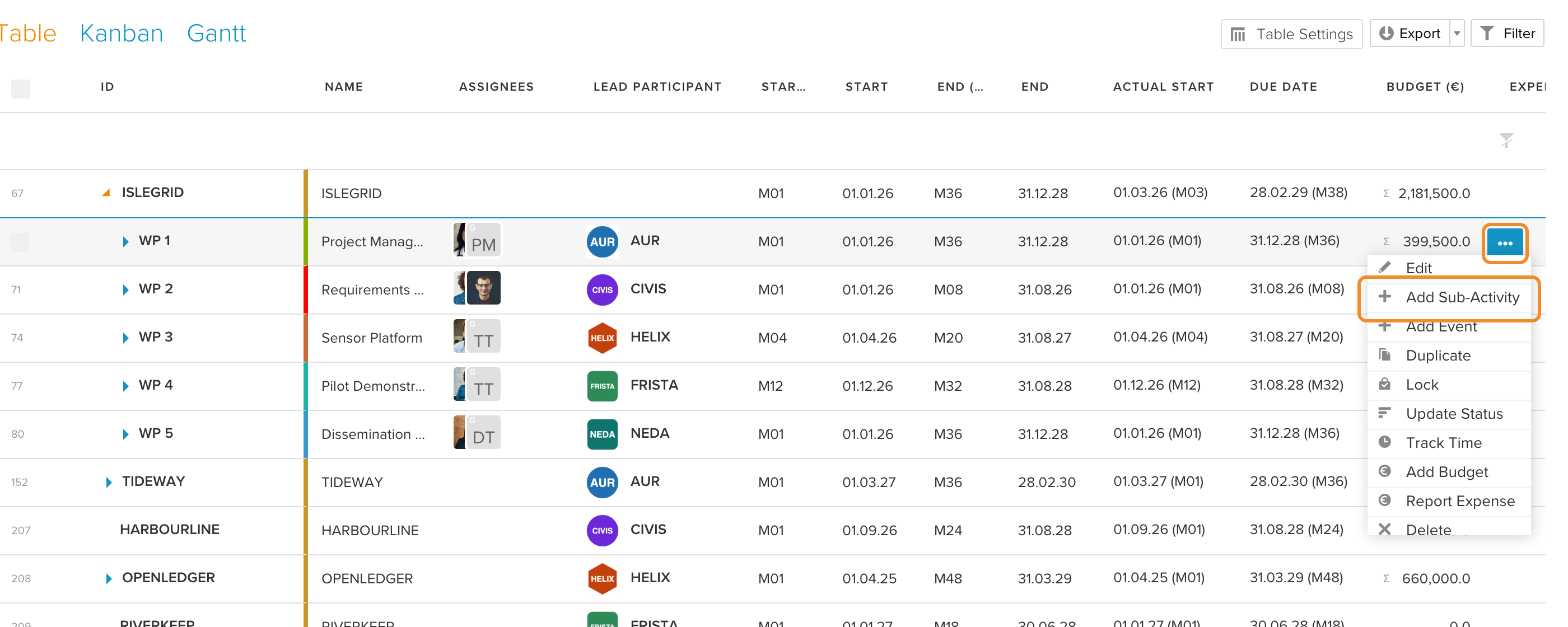
Hover over the project or parent item (work package or task) the new activity belongs to, click the … button at the end of its row and select Add Sub-Activity. This opens the New Activity sidebar.
Alternatively, click + Add Activity at the bottom of the Workplan. The new activity is then added at the end of the first project; you can choose another position before saving (see the tip below).
- 3
- In the sidebar, you can set the following for the new activity:
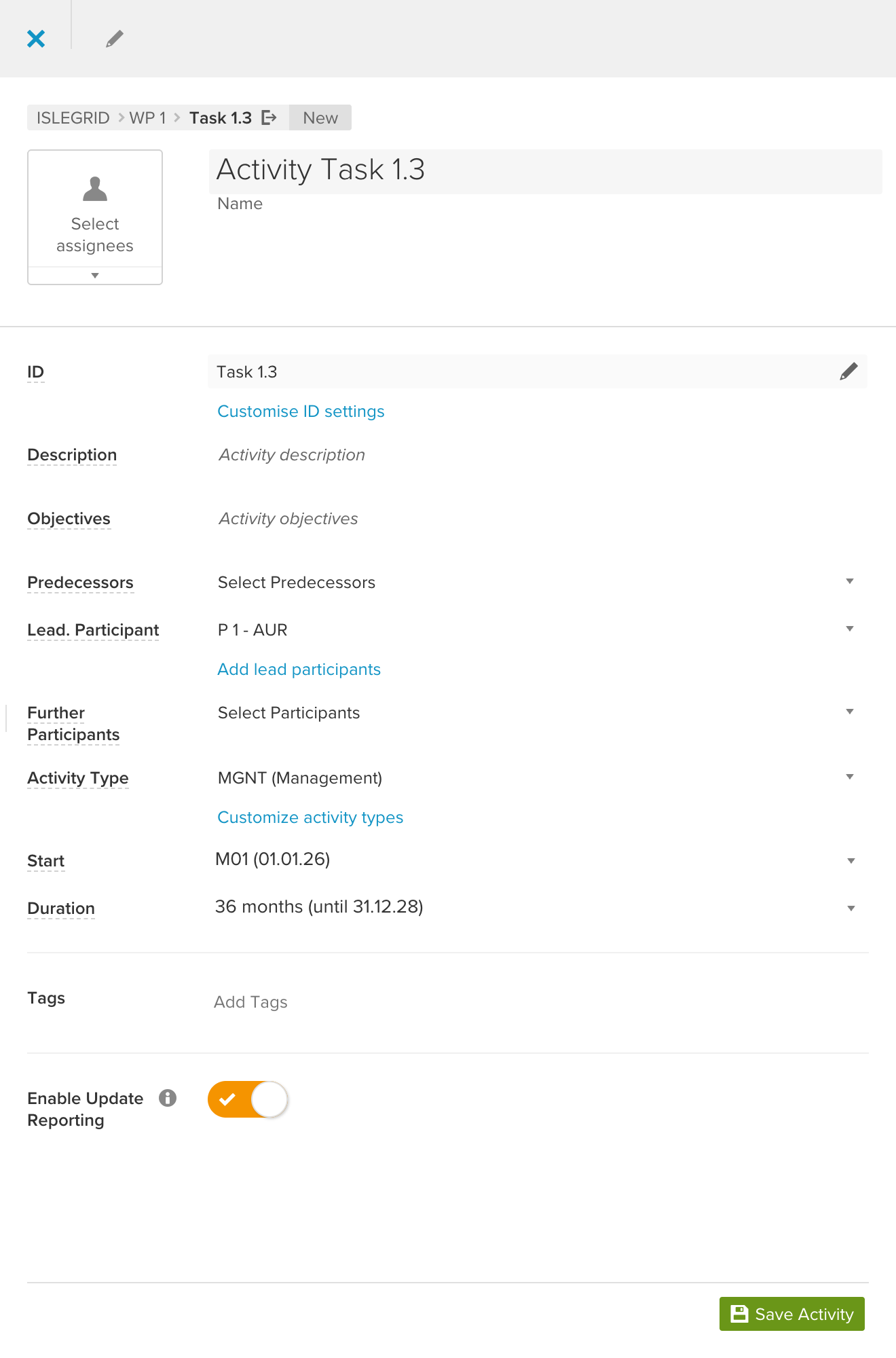
- Name: Click the placeholder and enter a name.
- Assignees (optional): Select team members responsible for the activity.
- ID: An ID is generated automatically. You can:
- Customize the ID format under Customisation settings
- Manually override the default by clicking the Edit icon and entering your preferred ID
- Description (optional): Add a description.
- Objectives (optional): Add an objective.
- Predecessors (optional): Select other activities or deliverables and milestones that must be completed before this activity can begin.
- Lead. Participant (optional): Assign the participant responsible for the activity. You can add up to 3 lead participants.
- Further Participants (optional): Add additional participants involved in the activity.
- Activity Type: Select the appropriate type from the dropdown. These types are defined by the workspace template (modifiable under Customisation settings).
- Start: Select a start month for the activity, with M01 aligning with the project's start date.
- Duration: Set the activity duration in months.
💡 Good to know: When you add sub-activities to an activity, its duration automatically updates to span from the start of the earliest sub-activity to the end of the latest one.
- Tags (optional): Categorise the activity by adding tags
- Enable Update Reporting: Toggle this on/off to activate status reporting for this activity.
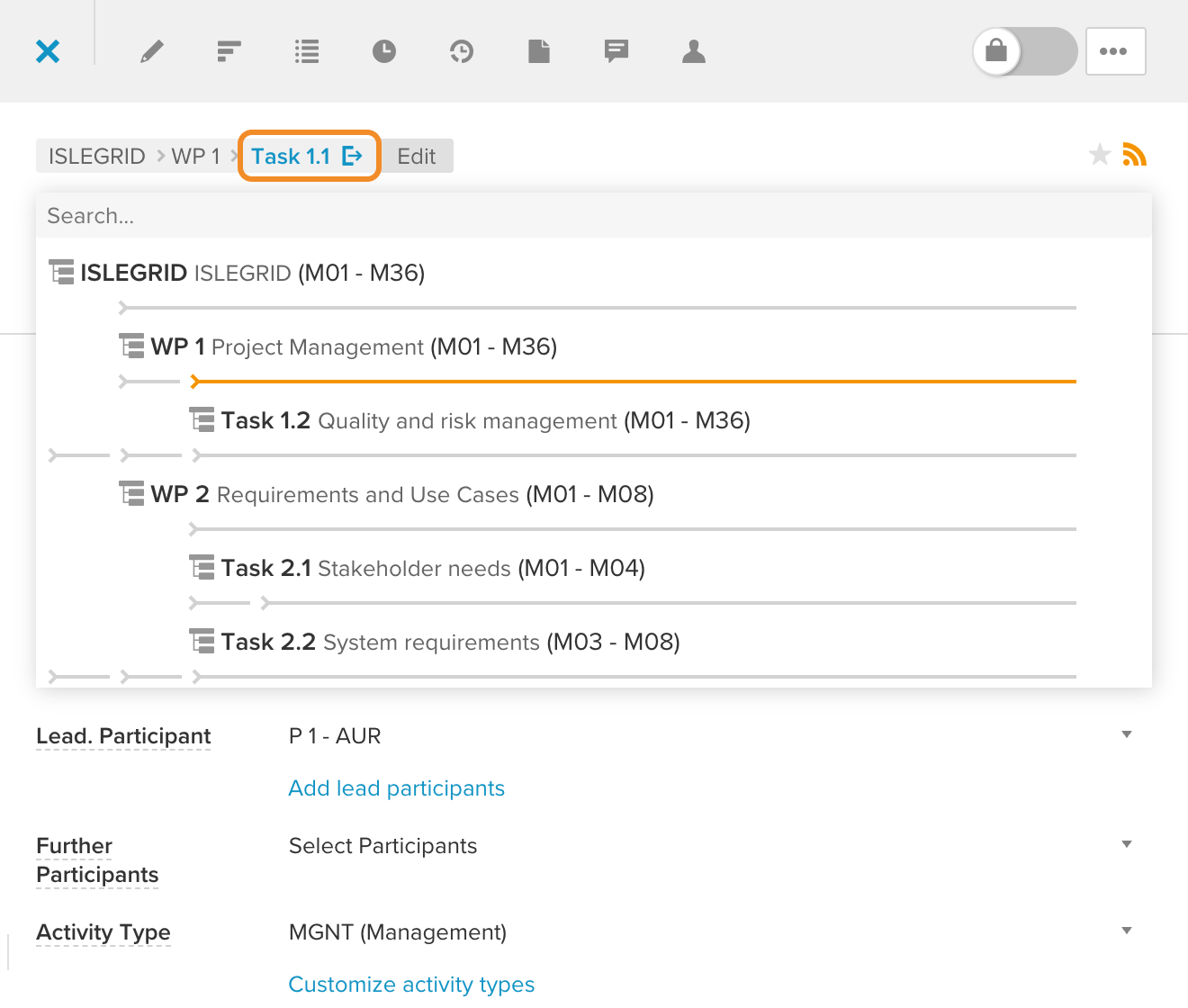
💡 Tip: To insert the activity at a specific location, click its ID with the arrow icon in the path at the top of the sidebar (for example WP 1 › Task 1.3). A list of the Workplan opens; click the line where the activity should be placed.
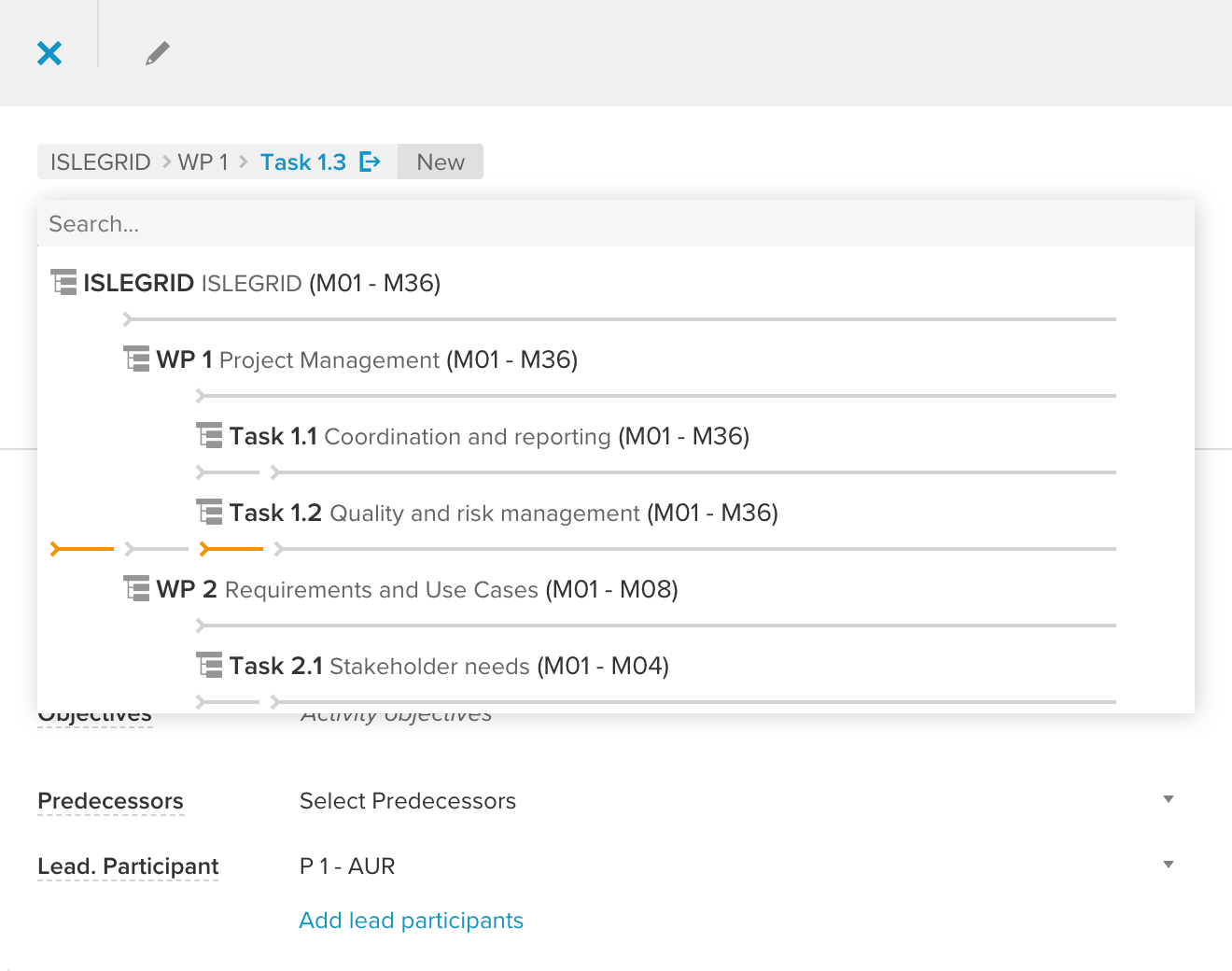
Changing position (except to last) will update the ID of the moved activity and any following items.
If no position is specified, the new activity will be added to the end of the project's activity list.
- 4
- Click Save Activity to add it to your Workplan.
Editing and updating activities
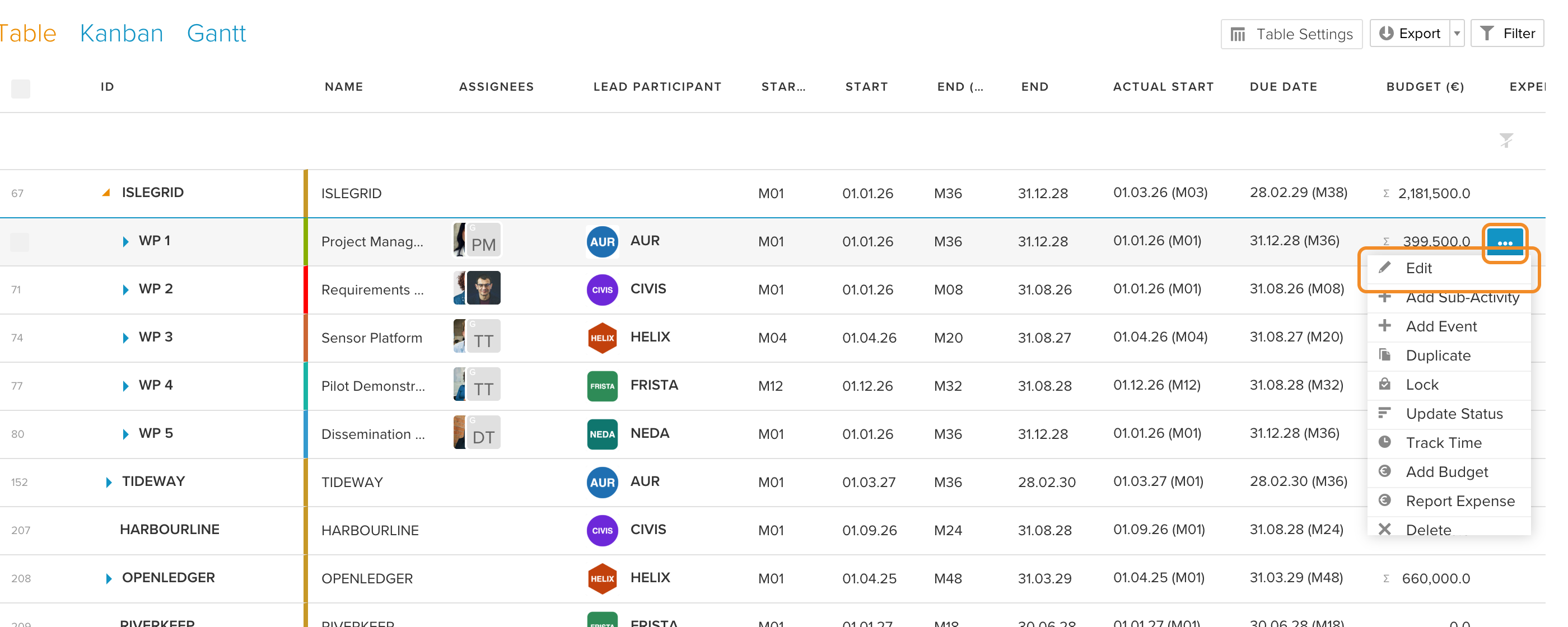
Click the activity, or click the … button at the end of its row and select Edit, to open the sidebar.
In the sidebar, update any the fields as needed:
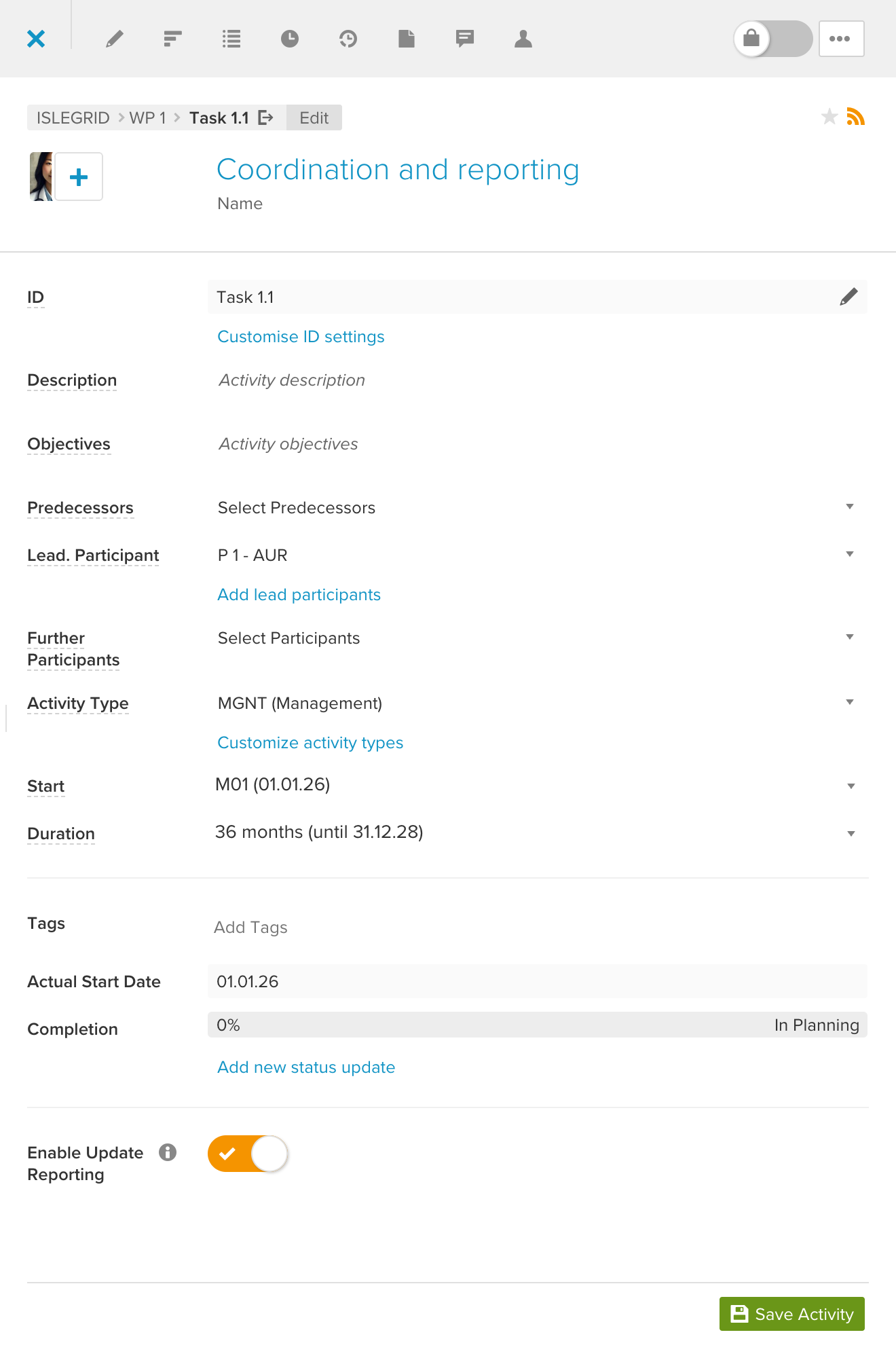
- Name: Update the name of the activity.
- Select assignees: Click the plus icon and update assignees for the activity.
- ID: An ID is generated automatically. You can:
- Customize the ID format under Customisation settings
- Manually override the default by clicking the Edit icon and entering your preferred ID
- Description: Edit the description
- Objectives: Edit the objectives
- Predecessors (optional): Select other activities or deliverables and milestones that must be completed before this activity can begin.
- Lead. Participant (optional): Assign the participant responsible for the activity. You can add up to 3 lead participants.
- Further Participants (optional): Add additional participants involved in the activity.
- Activity Type: Select the appropriate type from the dropdown. These types are defined by the workspace template (modifiable under Customisation settings).
- Start: Select a start month for the activity, with M01 aligning with the project's start date.
- Duration: Set the activity duration in months.
💡 Good to know: When you add sub-activities to an activity, its duration automatically updates to span from the start of the earliest sub-activity to the end of the latest one.
- Tags (optional): Categorise the activity by adding tags
- Enable Update Reporting: Toggle this on/off to activate status reporting for this activity.
- Actual Start Date, Actual Duration and Completion: shown once the activity has been saved. They reflect the progress reported for the activity; click Add new status update to report progress (see Reporting progress).
Click Save Activity to apply your changes.
Moving activities to another position
To move an activity to another position or under another project or activity, open it in the sidebar and click its ID with the arrow icon in the path at the top (a Move tooltip appears when the sidebar opens). A list of the Workplan opens, with a search field at the top. The orange line shows the current position; click the line where the activity should go. Then click Save Activity.
💡 Good to know:
- If you move an activity under a different project or task, and it starts earlier or ends later than its new parent, the parent will automatically adjust its timeline to match.
- If you move an activity to a new position (not at the very end), the system will automatically update its ID — as well as the IDs of any following tasks and sub-tasks — to keep everything in the right order.
- A project or activity with sub-activities takes its start and duration from them. To change its timeline, adjust the dates of its sub-activities.
- The sidebar warns you if an activity starts before one of its predecessors ends, or if its duration does not fit into the parent activity.
- Locked items (… › Lock) cannot be edited or moved until they are unlocked.