
Create and edit personnel cost rates
Personnel cost rates (labor or staff cost rates) define how personnel costs are calculated for a specific participant in a project. They are configured per participant in the Financial profile and are used both for:
- Budget planning - when you plan effort for future work
- Cost reporting - when you report actual effort or personnel expenses
For each participant, you can create as many personnel cost rates as needed. These rates can be:
- Average personnel cost rates for budgeting at a higher level, for example: "Average Research Staff Rate"
- Person-specific or role-specific rates for more accurate planning and reporting, for example: "Project Manager Rate" or "Salary of Mark Johansen"
Note: To create or manage personnel cost rates, you must have at least Edit access rights to the participant (see "Roles, access levels, and access rights" and "Manage workspace plan versions"). Export and 'Upload to update' functions require Manage access rights.
Tip: If you already have a list of personnel cost rates, you can import them into your workspace instead of adding them one by one.
In this article you will find:
How personnel cost rates work
The personnel cost rates you define for a participant are used:
-
When budgeting
You select a personnel cost rate and enter planned effort (in person months, person days or person hours, depending on the unit). EMDESK calculates the personnel costs by multiplying the effort with the selected rate.
-
When reporting personnel costs
You select a personnel cost rate and report the actual effort or time. EMDESK calculates the reported personnel costs in line with the configured rate.
Productive hours and EU projects: A new personnel cost rate starts with 8 hours a day and 22 days a month. That is 176 productive hours a month and 2,112 a year.
Many funding programmes fix productive time differently. Horizon Europe, for example, uses 215 productive days a year, which is about 17.92 days a month and 1,720 hours a year. EMDESK does not set this for you. Enter the values your programme or organisation uses in Hours a day and Days a month on every rate you create.
The line below the two fields shows the resulting annual and monthly productive hours, so you can check your entry. Rates you created earlier keep the values they were saved with.
Create personnel cost rates
You manage personnel cost rates in the Financial profile of a participant.
- 1
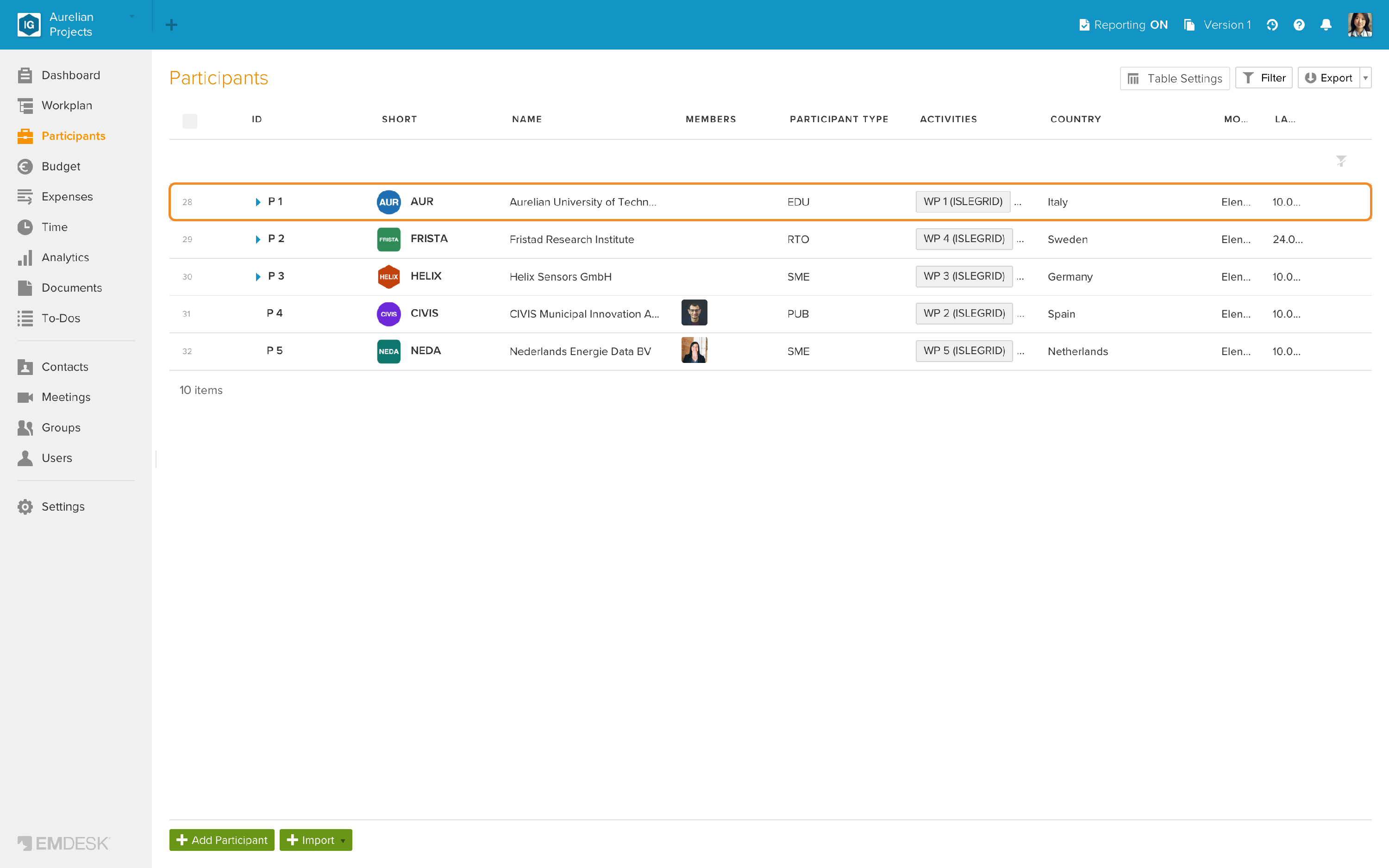
- Click Participants in the main menu to open the Participants section.
- 2
- Click the participant whose personnel cost rates you want to create.
- 3
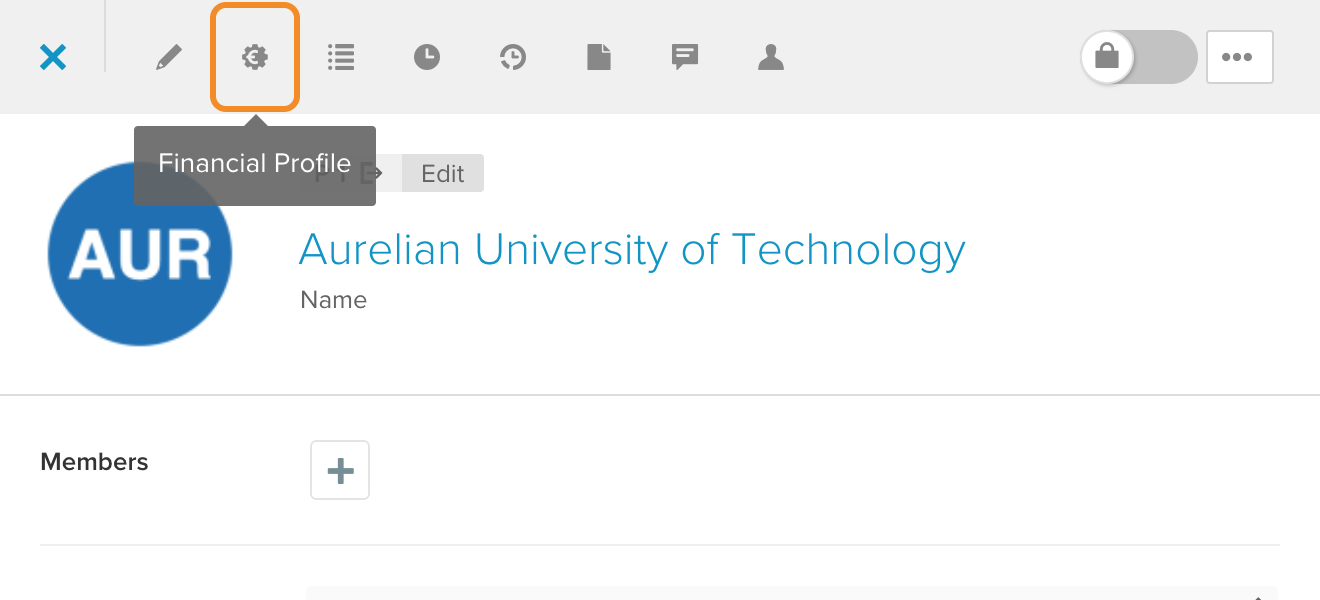
- A sidebar for this participant opens. Select the Financial Profile tab (the gear icon with the euro sign at the top of the sidebar).
- 4
- At the bottom of the sidebar, click + Add Personnel Cost Rate.

- 5
- A new sidebar opens where you define the personnel cost rate:

- Personnel Cost Rate: Click the blue placeholder and enter the rate (for example the amount per month, day or hour).
- Name: Enter a clear name for the rate, for example "Average plan rate", "PostDoc Student Salary" or "Mark Johansen".
- Unit: Choose the unit of the rate: Person Month, Person Day or Person Hour. This unit is used later when you plan effort or report time.
- Description (optional): Add a short description if needed, for example to document how the rate was calculated or which staff group it covers.
- Hours a day and Days a month: Set the working hours per day and working days per month. EMDESK shows the calculated annual and monthly productive hours, which are used in calculations where needed and help you check that the rate matches your internal rules.
- Enable for Budgeting: Switch this toggle on if the rate should be available when you create or edit budget items. If it is off, the rate cannot be selected in budgeting views.
- Enable for Expenses: Switch this toggle on if the rate should be available when you create or edit expense entries (actual costs). If it is off, the rate cannot be selected when reporting personnel costs.
- Valid from and Valid until (optional): Set the period in which the rate can be selected. Outside that period, EMDESK hides the rate when you create or edit a budget item or an expense entry. EMDESK does not choose a rate for you: if two rates are valid for the same period, both stay in the list and you pick one. Entries you saved earlier keep the rate they were saved with. If your rate changes, create a separate rate for each period, for example "Senior engineer 2026" and "Senior engineer 2027".
- 6
- Click Save Cost Rate in the bottom right corner to create the rate.
Tips:
Hide personnel cost rates from other users
You can hide a participant's personnel cost rates from users who only have Read access to that participant by switching on Hide personnel cost rates. Those users can still work with budgets and expenses, but EMDESK blurs the figures instead of showing them: the rate values, and the personnel cost rate, costs and funding of every entry that uses one of this participant's rates, including the column totals. Entries without a personnel cost rate stay readable, and exported tables leave these columns empty. See Why are cost figures blurred in Budget or Expenses?
Users with Edit or Manage access to the participant see all figures, and only they can switch the setting on or off (see Roles and Access Rights).

Set a default personnel cost rate
You can mark one personnel cost rate as the default for this participant by clicking the star icon next to the rate. The default rate is preselected when creating new budget items or expense entries for this participant, which speeds up data entry and ensures consistent use of rates.

Updating existing personnel cost rates
To edit an existing personnel cost rate:
- 1
- Open Participants in the main menu and click the participant you want to edit to open the sidebar.
- 2
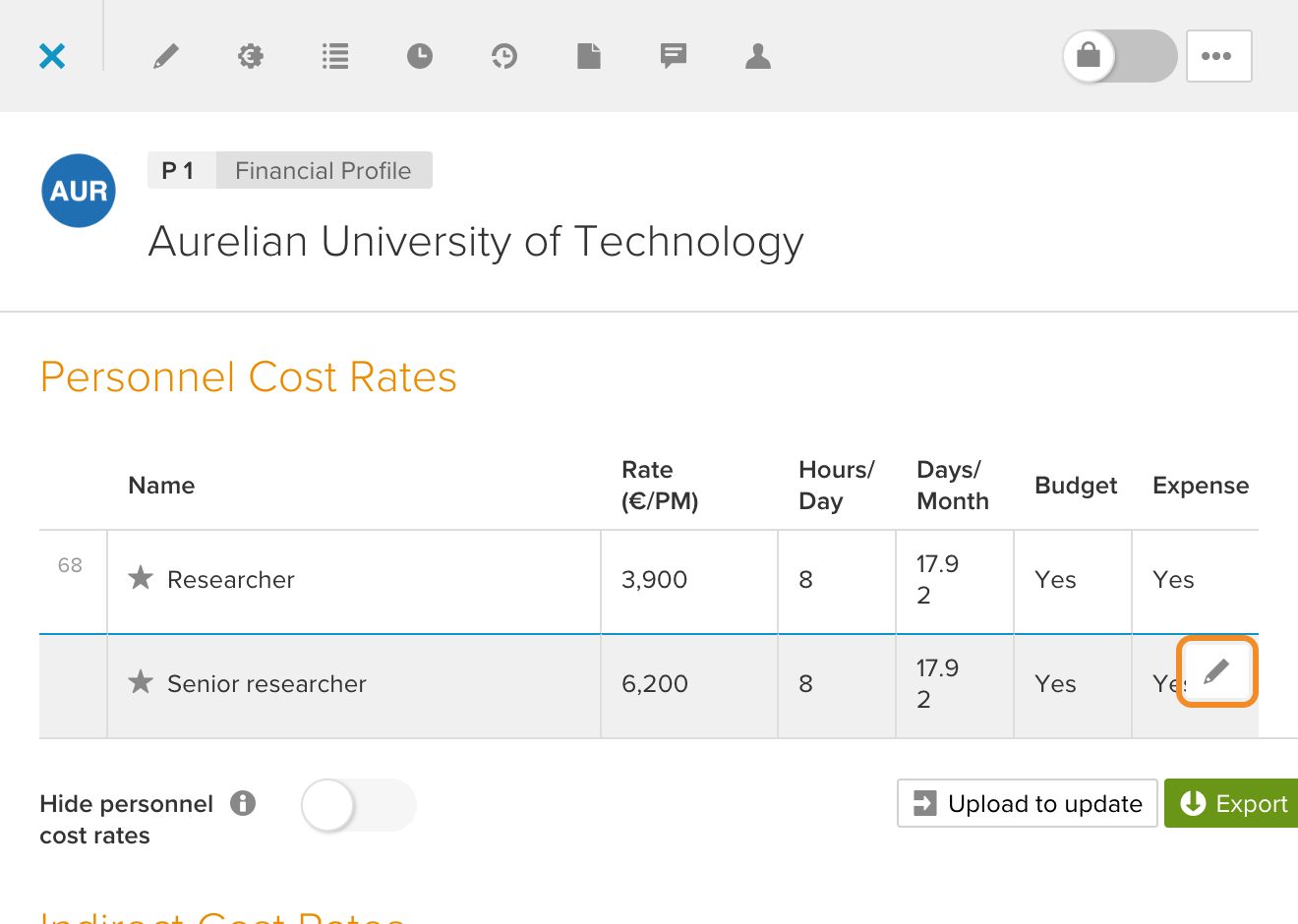
- Select the Financial Profile tab.
- 3
- Hover over the personnel cost rate that you want to change and click the Edit icon. The personnel cost rate opens in a separate sidebar.

You can adjust:
- Personnel Cost Rate: Click the current blue value and update the rate.
- Name: Update the name if needed
- Unit: Change the unit between Person Month, Person Day or Person Hour
- Description (optional): Update the description.
- Hours a day and Days a month: Adjust working hours and days
- Enable for Budgeting: Turn the toggle on or off depending on whether this rate should be selectable for budget items.
- Enable for Expenses: Turn the toggle on or off depending on whether this rate should be selectable for expense entries.
- Valid from and Valid until (optional): Adjust the period in which the rate can be selected.
- 4
- Click Save Cost Rate in the bottom right corner to apply your changes.
Unit conversion: When you change the unit, for example from Person Month to Person Day, EMDESK asks: "Should we convert the rate based on the new unit?"
- Choose Yes to keep the same cost. EMDESK recalculates the number in the rate field. At 22 days a month, 8,800 per person month becomes 400 per person day.
- Choose No to keep the number you see. EMDESK then reads that number in the new unit, so the cost changes: 8,800 per person month becomes 8,800 per person day, 22 times more.
Check the rate value after you answer and before you save.
Note: If you change a rate that has already been used in existing budgets or expenses, EMDESK asks how to update the linked budget items and expenses:
- Update Costs recalculates the costs of each entry with the new rate, or
- Update Effort recalculates the effort of each entry.

Note: Read further how to duplicate and delete personnel cost rates, as well as how to set and edit indirect cost rates.
Note: The Hours a day and Days a month fields on this screen set how EMDESK converts between rate units (Person Month, Person Day, Person Hour). They are not where you enter effort. You enter planned effort on a budget item: in the Budget view, add an item and select the activity, the participant and a personnel Cost Category of the type Rate. The effort field and its unit then appear next to Cost at the top of the sidebar, and you pick the rate under Cost Rate. Make sure the rate is saved and Enable for Budgeting is switched on, otherwise it cannot be selected there.