
Setting Funding Rules and Rates
Funding rules allow you to set up how project funding is calculated. They determine what percentage of the budget or expenses will be covered by funding.
To apply funding correctly, you need to create funding rules. A funding rule includes a funding rate (%), which is used to calculate the funded amount based on your project’s structure and funding scheme.
There are two ways to define which budget and expense lines a funding rule applies to.
A general rule applies by category, and is the right choice for almost every rule you create. It matches on any combination of:
- Activity type (e.g., Research, Management)
- Participant type (e.g., University, SME)
- Cost category (e.g., Personnel, Equipment)
An explicit rule applies to one specific participant working on one specific activity. Use it for the exceptions a consortium negotiates individually — a partner with a different rate on a single work package, for example. See Set a rate for a specific participant and activity.
By defining funding rules, you ensure that the system automatically calculates funding according to your project’s structure.
For example, if you participate in both Horizon Europe and LIFE projects, create two activity types under Settings → Customization → Activity Types (e.g., “Horizon Europe” and “LIFE”). Then assign activities from each project to the respective type and in Settings → Customization → Funding Rules, create separate rules and set them to apply only to one activity type. This allows you to simulate project-specific funding schemes within multi-project environments.
You can define the funding rate in EMDESK by setting up funding rules under Settings → Customization → Funding Rules. This allows you to configure different funding rates based on participant type, activity type, and cost category.
For a detailed step-by-step guide, please refer to this video tutorial:
How to Set Up a Funding Rule:
- Go to Settings → Customization and scroll down to Funding Rules
-
Click Add Funding Rule and enter a name.

-
Specify the participant type, activity type and cost category the rule should apply to. Leave any of them on “All” if the rule is not limited by that criterion.
To set the rate for one specific participant and activity instead, click Set rule for a specific participant and activity below the fields — see the next section.
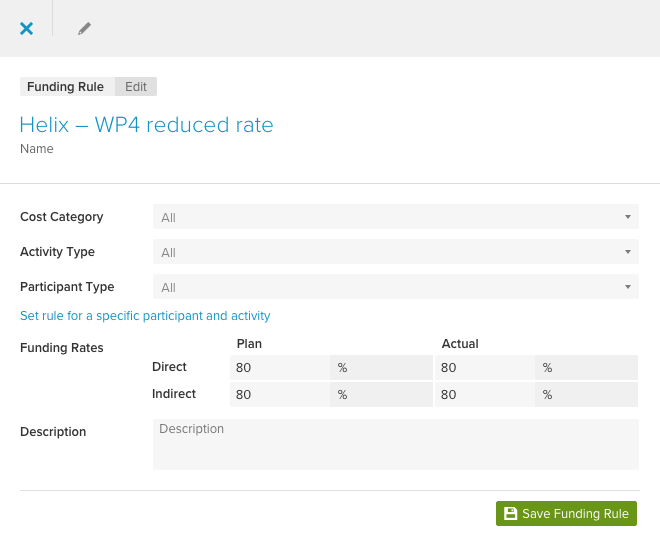
- Enter the funding rate for plan and actual direct and indirect costs.
- Enter a description for the rule. A description is required — the rule cannot be saved without one.
- Save the rule.

Important: Assigning the Correct Types
For the funding rule to apply correctly, you must assign your projects, activities, and participants to the relevant types:
- In the Work Plan, make sure your project and activities are assigned to the correct activity type that matches your funding rule.
- In the Participants section, verify that organizations are assigned to the correct participant type (e.g., Research Institute) if you have rules based on this.
This applies to general rules only. An explicit rule names the participant and the activity directly, so it works regardless of which types they are assigned to.
Set a rate for a specific participant and activity
Sometimes one partner has a different funding rate on one particular activity — a rate negotiated individually, or a work package funded under different terms. Instead of creating an activity type or participant type just to carry that exception, you can pin the rate directly to the participant and activity concerned.
An explicit rule is an exception: it overrides whichever general rule would otherwise apply to those budget and expense lines, and leaves every other line untouched.
- Go to Settings → Customization and scroll down to Funding Rules.
- Click Add Funding Rule and enter a name — something that identifies the exception, for example Org X – WP4 special rate.
- Click Set rule for a specific participant and activity below the criteria fields.
-
Select the Participant and the Activity. Both are required.
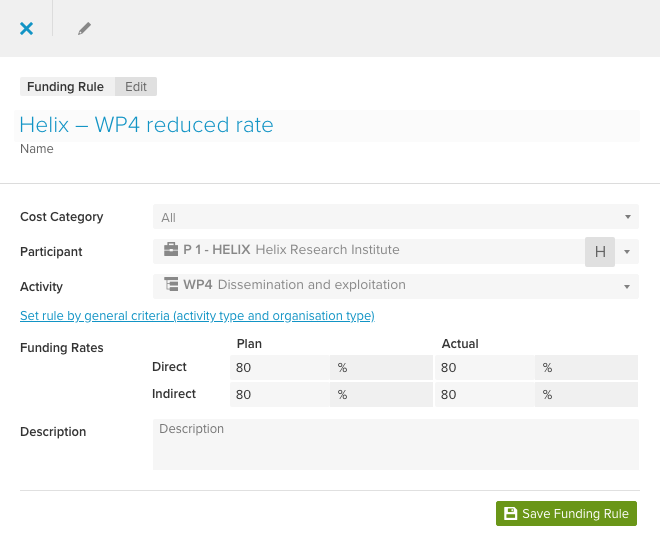
- Optionally narrow the rule to a single Cost Category. Left on “All”, the rule covers every cost category for that participant and activity.
- Enter the funding rate for plan and actual direct and indirect costs.
- Enter a description for the rule. A description is required — the rule cannot be saved without one.
- Click Save Funding Rule.
Explicit rules are listed separately, in an Explicit Funding Rules table below the general ones. The table appears as soon as you create your first explicit rule. Use the ⋯ menu at the end of a row to edit or delete a rule.

Good to know
- A rule is either general or explicit. Switching a rule to explicit clears its activity type and participant type, and switching back clears its participant and activity.
- Both a Participant and an Activity must be set. A rule for one participant across all activities is not possible — create one rule per activity, or use a participant type for a rule that covers the whole organisation.
- The option appears once the project has at least one participant and one activity.
- Project patterns carry general rules only. Explicit rules refer to participants and activities of one specific project, so they are not part of a pattern.
Changing or removing an explicit rule
Editing a rate recalculates the affected budget and expense lines automatically — you do not need to reopen the entries. Deleting the rule, or deleting the participant or activity it refers to, makes those lines fall back to the general rule that applies to them.
Which rule applies
Several rules can match the same budget or expense line. EMDESK always applies the most specific matching rule.
- A criterion left on “All” matches anything.
- A rule can only apply if every criterion it does set matches the line. A single mismatch rules it out.
- Of the rules that match, the one with the most specific criteria wins. From most to least specific: Participant → Activity → Cost Category → Activity Type → Participant Type.
- If two rules are equally specific, the one created first applies.
- A rule with every criterion on “All” applies to everything else, as a fallback.
In practice this means:
- An explicit rule always wins over a general rule, because naming a participant and an activity is more specific than any combination of types.
- Between two explicit rules for the same participant and activity, the one limited to a cost category wins for that category, and the other covers the rest.
- Lines that are not tied to a participant or an activity are never affected by explicit rules — they keep following the general rules exactly as before.
Example 1:
Your programme funds 50% in general and 75% for research, funds personnel costs of non-profit organisations (NPOs) at 100%, and funds nothing for travel, management or large enterprises. You create one rule per statement:
| Rule | Participant type | Activity type | Cost category | Funding |
|---|---|---|---|---|
| General | All | All | All | 50% |
| Research | All | Research | All | 75% |
| NPO personnel | NPO | All | Personnel | 100% |
| Travel | All | All | Travel | 0% |
| Management | All | Management | All | 0% |
| Large enterprises | Large enterprise | All | All | 0% |
What EMDESK applies, because the most specific matching rule wins:
- Travel in a research activity: 0%. A cost category is more specific than an activity type.
- An NPO's personnel costs in a research or management activity: 100%. The NPO personnel rule sets two criteria, so it wins.
- A large enterprise's costs in a research activity: 75%, not 0%. Participant type is the least specific criterion, so the Research rule wins.
To give large enterprises 0% in research activities as well, add one more rule with participant type Large enterprise and activity type Research at 0%. It sets two criteria, so it wins over the Research rule. Check the result in the Funding Rate Name column in Budget, which shows which rule funded each line.
Example 2:
You manage four projects, two Horizon Europe and two LIFE. You create:
- Two activity types: “Horizon Europe” and “LIFE”
- Three funding rules:
- 100% for Horizon Europe activities
- 60% for LIFE activities
- 0% for Coordination/Management regardless of program
Assign each activity to its correct type and the rules will apply automatically.
Once everything is correctly assigned, the funding rule will automatically apply to budget planning and expense reporting.
Hint:
To see how funding is applied in your project, you need to adjust your table settings:
- In Budget and Expenses, go to Table Settings and switch on the funding columns you need — Funding (Total), Funding (Direct Costs), Funding Rate, and Funding Rate Name, which tells you which rule funded each line.
- In Analytics reports, go to Settings and activate the Funding option to make it visible in reports.
These steps will allow you to track funding allocations and calculations directly within EMDESK.
